


The Million-Euro Question Nobody Is Actually Modeling
€1,000,000 is a number that circulates constantly in Bitcoin mining discussions, but rarely as a fully constructed model.
It is often framed as speculation. In reality, reaching seven figures through mining is not about hope, it is about arithmetic.
Most participants never build the model. They rely on sentiment, assumptions, or market narratives. Meanwhile, serious operators approach mining like engineering: defined inputs, controlled variables, and measurable outputs.
This analysis builds a complete, data-driven pathway from €0 to €1,000,000 using 2026 mining economics, real hosting costs, and a compounding reinvestment strategy.
Every variable is explicit. Every assumption is stated. Every result is reproducible.
- Electricity cost: $0.04/kWh
- Uptime: 98% guaranteed (with compensation)
- Warranty: 7 years
- Deployment speed: 48 hours
The Model: Core Assumptions
TABLE — BASELINE PARAMETERS
| Parameter | Value |
| Target | €1,000,000 portfolio |
| Starting capital | €25,000 |
| Hardware | Antminer S21 XP Hydro (270 TH/s) |
| Unit cost | ~€8,200 (hosted) |
| Electricity | $0.04/kWh |
| Power consumption | 5,000W |
| Daily electricity | €4.42 per unit |
| Network hashrate | ~800 EH/s |
| BTC price scenarios | €82K / €105K / €140K |
| Difficulty growth | +2.5% per quarter |
| Reinvestment rate | 75% |
| Uptime | 98% |
| Warranty | 7 years |
| BTC strategy | 25% hold / 75% reinvest |
The model is based on a €1,000,000 target portfolio, starting from an initial capital of €25,000. It assumes the use of the Antminer S21 XP Hydro (270 TH/s), with a hosted unit cost of approximately €8,200. Each unit operates at a power consumption of 5,000W, resulting in a daily electricity cost of about €4.42, based on an energy price of $0.04 per kWh.
The broader network conditions assume a total hashrate of approximately 800 EH/s, with difficulty increasing by 2.5% per quarter. Bitcoin price scenarios are modeled at €82,000, €105,000, and €140,000 to reflect varying market conditions.
Operationally, the model assumes 98% uptime and a hardware warranty period of 7 years. From a capital allocation perspective, 75% of mined Bitcoin is reinvested into scaling operations, while 25% is held as a long-term strategy.
Phase 1 — Entry (Months 1–6)
Why €25,000 Works
€25,000 is not arbitrary — it is the threshold where mining becomes scalable. Below this level, growth is too slow. Above it, capital efficiency drops.
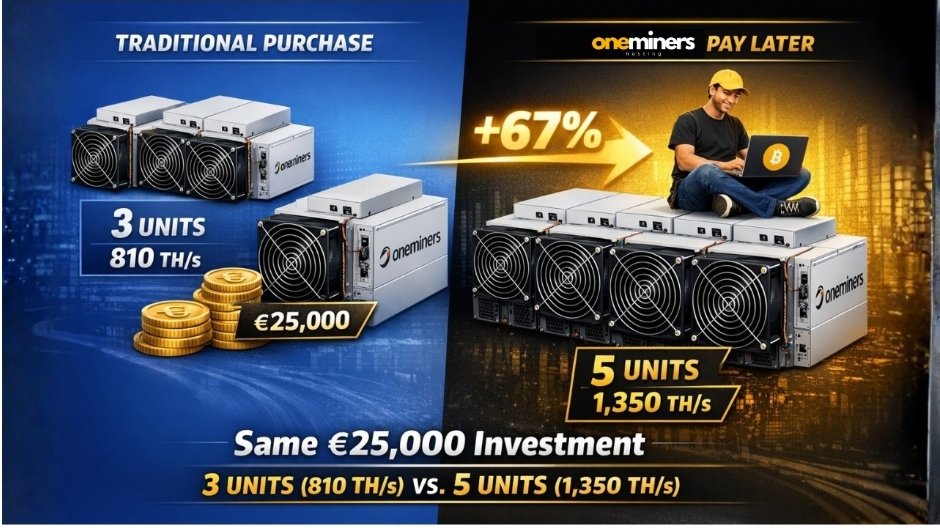
With a standard purchase, €25K deploys 3 mining units (810 TH/s), generating roughly:
- ~€1,285/month gross
- ~€887/month net after electricity
However, financing changes the structure entirely.
The Leverage Effect
Using a 25% upfront financing model, the same €25K can deploy 5 units (1,350 TH/s) instead of 3.
That is a 67% increase in hashrate from identical capital.
Cash flow becomes uneven in the first 6 months due to quarterly payments, but operational capacity is significantly higher from day one
End of Phase 1
By month 6:
- 5 machines are fully operational
- Financing is nearly cleared
- ~0.077 BTC accumulated
- Cash flow begins stabilizing
The foundation is now built.
Phase 2 — The Compounding Engine (Months 7–18)
Once financing ends (around month 9), the system shifts into its most important phase: compounding.
75% of net revenue is reinvested into new hardware.
This creates a feedback loop:
- More machines → more revenue
- More revenue → faster expansion
By month 18:
- Operation grows from 5 → 7 units
- Expansion is fully self-funded
- No additional capital required
A key insight here: even a small cost difference (e.g. $0.04 vs $0.06/kWh) compounds into tens of thousands of euros over time.
Phase 3 — Acceleration (Months 19–36)
This is where growth becomes visible.
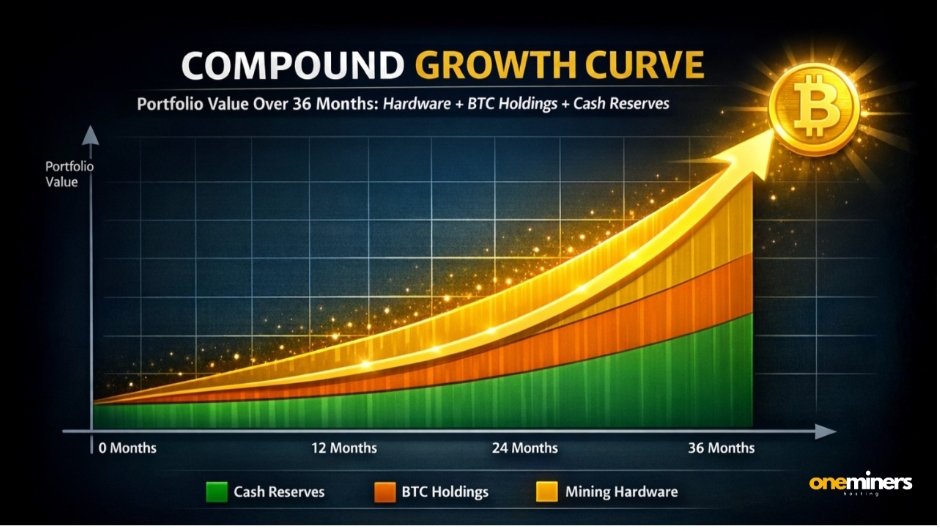
Each reinvestment cycle adds new units faster than the previous one. The system transitions from linear to accelerating growth.
By the end of year 3:
- ~12 mining units
- ~0.98 BTC accumulated
- ~€194,900 total portfolio value
That is nearly 8× growth from the initial €25,000.
And importantly — acceleration is still increasing.
Phase 4 — Scaling to €1,000,000 (Months 37–60)
At this stage, the operation has reached critical mass.
Revenue per quarter becomes large enough to:
- Add multiple units per cycle
- Continue BTC accumulation
- Build meaningful cash reserves
Outcome depends primarily on Bitcoin price:
- Conservative (€82K BTC): ~€482,000
- Moderate (€105K BTC): ~€707,000
- Aggressive (€140K BTC): ~€1,090,000+
The €1M threshold is reached in the aggressive scenario — and approached closely in moderate conditions.
The Dominant Variable
Every financial model has one factor that matters most.
In Bitcoin mining, it is not Bitcoin price.
It is cost structure, specifically:
- Electricity price
- Uptime reliability
- Deployment speed
- Access to financing
A small inefficiency compounds dramatically over 5 years.
The difference between optimized and average infrastructure can exceed €180,000–€300,000 over the full cycle.
Risk Framework
No model is complete without acknowledging risk.
The main threats include:
- Bitcoin price drawdowns
- Difficulty increases
- Hardware failure
- Regulatory shifts
However, mitigation exists:
- Continuous mining lowers cost basis
- Reinvestment adapts to difficulty
- Long warranties reduce hardware risk
- Geographic flexibility protects operations
The model is resilient — but not risk-free.
Mining hardware improves approximately 25–40% per generation.
This has a major impact:
- Higher efficiency
- Greater output per unit
- Faster reinvestment cycles
When upgrades are included, the timeline to €1,000,000 compresses to roughly 48–52 months, instead of 60.
Model Outcome
This model is not speculation.
It is a structured system built on:
- Defined inputs
- Controlled costs
- Compounding reinvestment
The outcome is not driven by hype.
It is driven by execution.
The individuals who reach seven figures are not guessing.
They are following a model — and optimizing it relentlessly.
Final Perspective
The €1,000,000 question was never about if it could be achieved.
The model demonstrates clearly that, under defined conditions, with disciplined reinvestment and controlled costs, reaching seven figures through Bitcoin mining is not speculative—it is structurally attainable.
The real variable has always been efficiency.
Efficiency in capital deployment.
Efficiency in energy sourcing.
Efficiency in scaling decisions.
Efficiency in execution over time.
Because in a compounding system, small inefficiencies are not linear—they are exponential in their impact. A marginally higher electricity cost, a delay in deployment, or suboptimal reinvestment timing can translate into hundreds of thousands of euros over a five-year cycle.
Conversely, optimized operations do not rely on market timing or luck. They rely on precision. On consistency. On engineering the system correctly from day one and continuously refining it.
In that context, the outcome is no longer uncertain.
The difference between those who approach €1,000,000—and those who reach or exceed it—is not belief, nor timing, nor even capital.
It is how efficiently the model is executed.