

Math often feels intimidating, but some concepts are much simpler than they look. One common example is converting fractions into decimals. This skill shows up everywhere—from cooking and shopping to schoolwork and basic calculations. In this article, we’ll walk through the idea in a friendly, easy-to-follow way so you can feel confident using it in real life.
What Does the Fraction 3/4 Mean?
Before jumping into decimals, it helps to understand what the fraction itself represents. A fraction is a way of showing parts of a whole. When you see 3/4, it simply means three equal parts out of four total parts.
Understanding Numerators and Denominators
The top number, called the numerator, tells you how many parts you have. The bottom number, the denominator, tells you how many equal parts the whole is divided into. In everyday terms, imagine slicing a pizza into four equal pieces and eating three of them.
Fractions in Daily Life
Fractions appear in recipes, measurements, time, and money. Whether you’re measuring ingredients or calculating discounts, understanding fractions makes daily tasks easier and more accurate.
How to Convert a Fraction into a Decimal
Turning a fraction into a decimal is a straightforward process. You divide the numerator by the denominator using basic division.
Step-by-Step Conversion Method
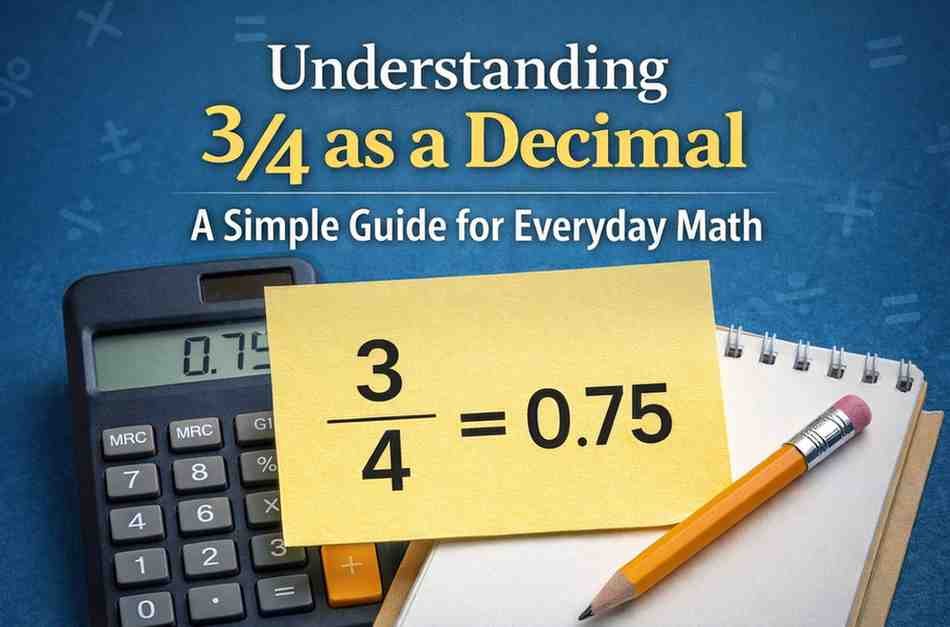
To convert 3/4 as a decimal, divide 3 by 4. When you do this calculation, the result is 0.75. That’s it—no complicated formulas or advanced math skills required.
Why Division Works
Decimals are another way of expressing fractions. Division helps translate the fraction into a number based on tenths, hundredths, or thousandths, which are easier to compare and calculate with in many situations.
Why Decimals Are Often More Useful
Decimals are commonly used because they are simple to work with, especially in calculations involving money, measurements, and percentages.
Easier Comparisons
Decimals allow quick comparisons. For example, it’s much easier to see that 0.75 is larger than 0.5 than it is to compare 3/4 and 1/2 at a glance.
Practical Applications
From calculating prices and discounts to understanding grades and statistics, decimals are everywhere. Knowing how to convert 3/4 as a decimal helps you move smoothly between fractions and real-world numbers.
Common Mistakes to Avoid When Converting Fractions
While the conversion process is simple, small mistakes can happen if you’re not careful.
Mixing Up the Numbers
One common error is dividing the denominator by the numerator instead of the other way around. Always remember: numerator ÷ denominator.
Rounding Too Early
Another mistake is rounding too soon. In this case, the decimal terminates at two places, but with other fractions, rounding early can lead to inaccurate results.
How This Concept Is Taught in School
Understanding fraction-to-decimal conversion is a key part of math education. Teachers often use visual aids and real-life examples to make the concept clearer.
Visual Learning Methods
Pie charts, number lines, and shaded grids help students see how fractions relate to decimals. These tools make 3/4 as a decimal easier to grasp visually.
Building a Strong Math Foundation
Learning this skill early helps students tackle more advanced topics like percentages, ratios, and algebra with confidence.
Frequently Asked Questions
What is the decimal form of 3/4?
The decimal form is 0.75, found by dividing 3 by 4.
Is 3/4 a terminating decimal?
Yes, it ends at 0.75 and does not repeat.
Can 3/4 be written as a percentage?
Yes, 0.75 is equal to 75%.
Why do we convert fractions to decimals?
Decimals are often easier to use in calculations, comparisons, and real-world applications.
Conclusion
Understanding how fractions and decimals connect doesn’t have to be complicated. By learning how to convert 3/4 as a decimal, you gain a practical math skill that’s useful in everyday life. Whether you’re helping a student, managing finances, or just brushing up on basic math, this simple conversion builds confidence and clarity. With practice, fractions and decimals become less intimidating and more like helpful tools you can rely on anytime.